
6 LED Lighting Manufacturers in China for Wholesale, OEM and Custom Projects
Compare six LED lighting manufacturers in China for wholesale, OEM and custom projects—plus practical guidance on product specifications, certifications, quality control, packaging and supplier verification.

• Compare six China LED lighting manufacturers across residential, smart, outdoor, architectural and linear-lighting categories.
• Learn how to choose a factory based on product type, target market, OEM requirements and order volume.
• Understand what to verify before ordering, including factory identity, technical files, model-specific certificates and production capability.
• Compare LED product specifications such as drivers, LED chips, CRI, CCT, SDCM, IP rating, IK rating and photometric data.
• Learn which certifications may apply in Europe, North America, Australia and other destination markets.
• Use samples, written specifications and Golden Samples to control quality before bulk production.
• Reduce breakage risk with product-specific inspection and protective packaging for fragile or oversized lighting.
• Know when an integrated sourcing, inventory and fulfillment workflow may be more practical than managing several factories separately.
China Has No Shortage of Lighting Factories. The Real Challenge Is Fit.
A supplier directory can produce dozens of names in an afternoon. That is not the hard part. The hard part is finding a factory whose product, production model and documentation fit the light you plan to sell—and the market where it will be installed.
A pendant lamp, LED strip, smart bulb and outdoor floodlight do not fail in the same ways. Their components, testing, certification, packaging and after-sales risks are different. A polished sample proves only that one unit looked right. A certificate is useful only if it covers the exact model and destination market. And a low quotation means very little until the materials, inspection standard, packaging and delivery terms are fixed.
FFOrder works with lighting suppliers in China and supports sourcing, inspection, packaging, inventory and international fulfillment. The comparison below takes that operating reality as its starting point: not which factory has the longest catalogue, but which type of buyer and project each one may suit—and what still needs checking before an order scales.
For the wider supplier-search process beyond lighting, read our China Sourcing Guide 2026: Platforms, Agents & Best Practices.
LED Lighting Manufacturers in China at a Glance
The six companies below occupy different parts of the market. OPPLE has a broad lighting portfolio; LEEDARSON is more deeply focused on connected products. ZGSM serves outdoor and project lighting, RC Lighting architectural fixtures, and LEDYi strips and neon flex. Treat the table as a way to narrow a search, not as a substitute for reviewing the exact product.
The Short Answer
Work backward from the product and market rather than forward from the cheapest quote. Define the lighting category, destination country, voltage, technical requirements, certification needs, packaging and expected volume. Use that brief to build a shortlist. Then verify the legal entity and production site, request documents for the exact model, approve the product and packaging samples, inspect production, and start with a controlled order.
Direct factory contact can be enough when the specification is complete and your team can manage production, QC and freight. It becomes harder when the project involves several factories, custom components, fragile packaging, inventory and cross-border fulfillment. In that situation, a sourcing and fulfillment partner can reduce handoffs and keep the approved standard connected to the delivered order.
For help choosing between direct sourcing, agents and other purchasing routes, see our China Sourcing in 2026 buyer playbook.
Know Which Type of LED Manufacturer You Need
“LED lighting manufacturer” is a broad label. Begin with the application, then look for a supplier built around that product—not one that simply claims to make everything.
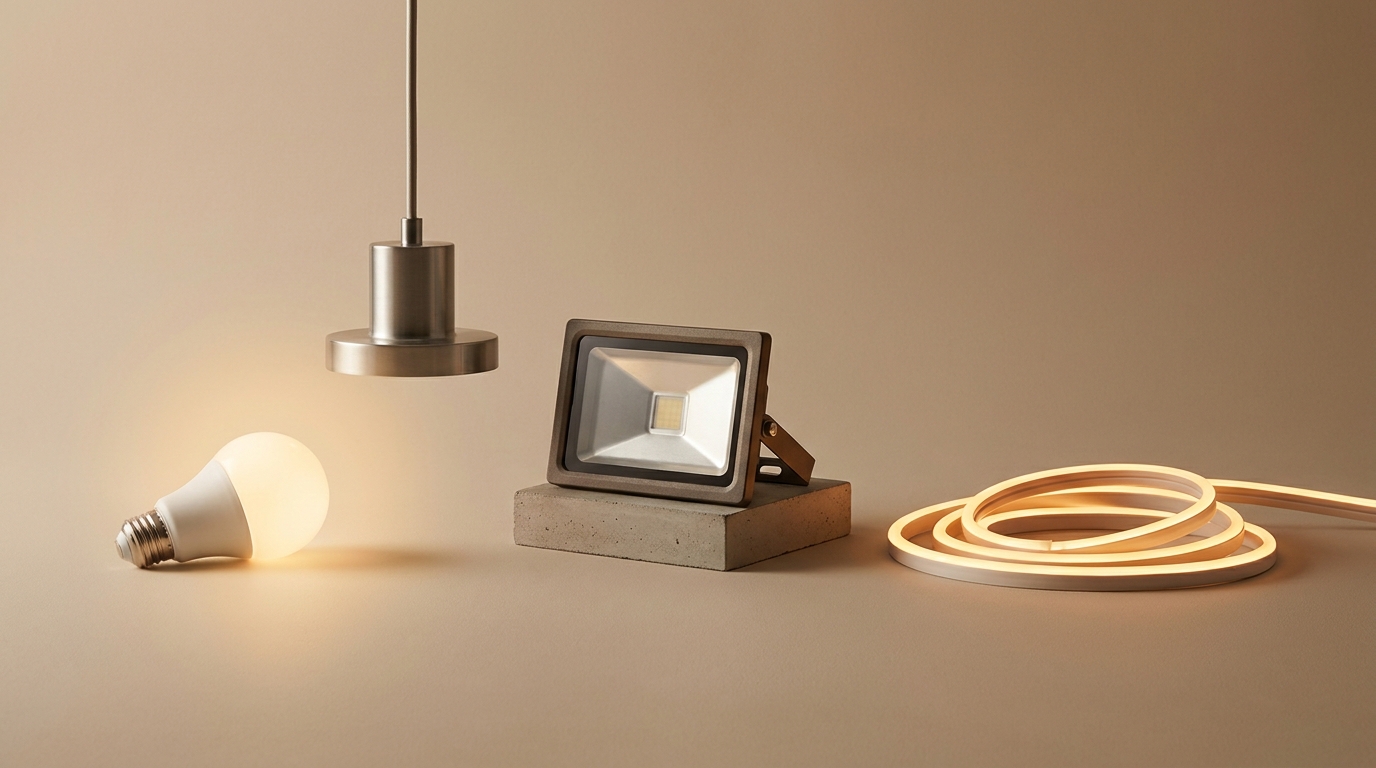
- Residential lighting: Bulbs, ceiling lights, downlights and spotlights. Check installation requirements, finish, colour temperature and batch-to-batch consistency.
- Decorative lighting: Pendant, wall, floor and table lamps. The structure and surface finish matter, but so do accessory control, carton size and protection against shipping damage.
- Commercial lighting: Track, panel and linear fixtures. Compare efficacy, CRI, beam distribution, flicker performance and the project files required.
- Industrial and outdoor lighting: High bays, street lights and floodlights. Review the driver, thermal design, enclosure, IP/IK ratings and model-specific test reports.
- LED strips and neon flex: Check the PCB, LED binning, voltage, colour consistency, waterproofing, connectors and voltage drop over longer runs.
- Smart lighting: Hardware is only part of the product. Confirm Wi-Fi, Bluetooth, Zigbee or Matter compatibility, as well as the app, firmware and control platform.
A very broad catalogue can reflect trading or outsourced production. It does not demonstrate equal capability in every category.
How We Selected These Manufacturers
We started with companies that have a verifiable business identity, an active official website and a defined product range: smart lighting, architectural fixtures, outdoor luminaires, LED components or strip lighting. That allows a practical buyer fit to be identified without pretending to rank every manufacturer by size.
We reviewed published information on manufacturing or product-development capability, OEM/ODM services, customization, export support, testing and certification. Company age, factory size and employee count are background context only. None proves that a particular product will meet its specification.
This review is based on current official websites and published company information. We did not submit an identical product brief to all six companies or place comparable test orders. Product capability and certificate references therefore reflect published claims, not independent performance testing. Buyers should confirm the factory, commercial terms and model-specific documentation before ordering.
OPPLE Lighting — Best for Broad Residential and Commercial Lighting
OPPLE offers consumer, professional and smart lighting, spanning lamps, residential fixtures and commercial lighting systems. The company is headquartered in Shanghai and reports manufacturing centres in Wujiang, Jiangsu, and Zhongshan, Guangdong. Buyers who need several lighting categories from an established supplier may find that breadth useful.
But scale is not a shortcut around qualification. OEM, private-label, purchasing and channel conditions depend on the buyer’s requirements and the selected model. Confirm those points with the relevant business unit. Certificates and technical files should also be checked against the exact product and destination market, not assumed from the OPPLE brand name alone.
LEEDARSON — Best for Smart and Connected Lighting
LEEDARSON makes LED bulbs, fixtures, luminaires, light sources, sensors, controls and other IoT devices. Its published smart-lighting range includes Wi-Fi, Bluetooth, Zigbee and Matter products for different regions and uses. That makes it a stronger candidate for connected-lighting work than for buyers who simply need a commodity bulb.
Its advantage is the combination of lighting hardware and IoT development. It also makes the supplier review more demanding. ODM scope, app and cloud-service responsibility, development work and support all need to be tied to the customer’s requirements and chosen model. Before treating a published product as commercially available, confirm the protocol, third-party compatibility, firmware maintenance, cybersecurity requirements, tooling, certification responsibility and expected volume.
MLS / Forest Lighting — Best for LED Components and High-Volume Programs
MLS is closely associated with LED packaging and application products; Forest Lighting is its international lighting brand. Company materials state that MLS produces SMD LED packages and operates production bases in Zhongshan, Yiwu, Xinyu and Ji’an. It also states that it provides OEM manufacturing for international companies.
That background can make MLS relevant for LED components, light sources, standardized fixtures and repeat-volume programs. Clarify the requirement before asking for a quote: LED packages, finished light sources and complete luminaires are not the same inquiry, and the relevant business unit may differ. Do not infer commercial conditions that the responsible unit has not published or provided for the specific request.
ZGSM — Best for Street, Outdoor and Industrial Lighting
ZGSM focuses on street lights, floodlights, high-bay fixtures, high-mast lighting, solar street lights and other outdoor or industrial products. Based in Hangzhou, it is positioned around engineering, municipal, wholesale and infrastructure projects rather than decorative residential lighting.
Its website publishes OEM/ODM options and CE, RoHS, ENEC, CB, SAA, UL and related test information. That makes ZGSM worth considering where project documentation matters, but logos are not enough. Request the certificate holder, covered model, applicable standard and current status. For each fixture, review LM-79 or LM-80 data where relevant, IES files, IP and IK ratings, operating temperature, driver configuration, surge protection, warranty handling, replacement parts and the procedure for units that fail after installation.
RC Lighting — Best for Architectural and Custom Lighting Projects
RC Lighting focuses on indoor and outdoor architectural products, including downlights, spotlights, track lights, wall washers, inground fixtures and landscape lighting. Its website presents customization for wattage, colour temperature, dimensions, LED components, housing finishes, optics, packaging and other project requirements.
This is the type of supplier to consider when a catalog fixture needs adapting for a hotel, retail, landscape or façade project. Its published OEM service covers design, prototyping, production and packaging. Still, “OEM available” does not establish that every structural change is done in-house. Identify which processes are owned and which are subcontracted; then confirm tooling capability, development cost, sample rounds, engineering responsibility, lead time and ownership of drawings and molds. Bulk production should be checked against the approved sample and written specification.
LEDYi Lighting — Best for LED Strips and Neon Flex
LEDYi specializes in LED strips, COB strips, neon flex and related linear-lighting products rather than a full range of finished luminaires. It publishes OEM and ODM support with different ordering conditions for standard and customized products. That focus makes it relevant to strip-light importers, architectural projects, wholesalers and brands building custom linear-lighting ranges.
Strip lighting brings its own technical questions. Confirm LED binning, CCT tolerance, SDCM, CRI, PCB thickness and copper content, voltage, power consumption, maximum run length and visible voltage drop. Waterproofing must fit the installation; an IP label by itself is not enough. Test the strip, driver, controller, connector and aluminium profile together, then verify which certificates apply to that exact configuration.
A Manufacturer List Is Only the Starting Point
A list helps find names. It cannot tell you how a particular product will perform. One supplier may have a mature range alongside another line with different components, documents or production partners. Certificates need to match the model; an approved sample needs a written specification; bulk production still needs inspection. Materials, finishes, drivers and packaging can all change after sampling.
A mixed lighting range may require separate specialists for pendants, strips, smart products and outdoor fixtures. Someone must own the specification, supplier communication, inspection, packaging and freight. A sourcing partner is most useful when several factories need to work to one product, quality, packaging and fulfillment process.
To narrow a supplier search by region and product type, see China Lighting Suppliers: 5 Key Sourcing Hubs for 2026.
How to Compare LED Lighting Manufacturers
Do not compare suppliers on headline wattage and unit price. Send each one the same RFQ and ask for the details below in writing.
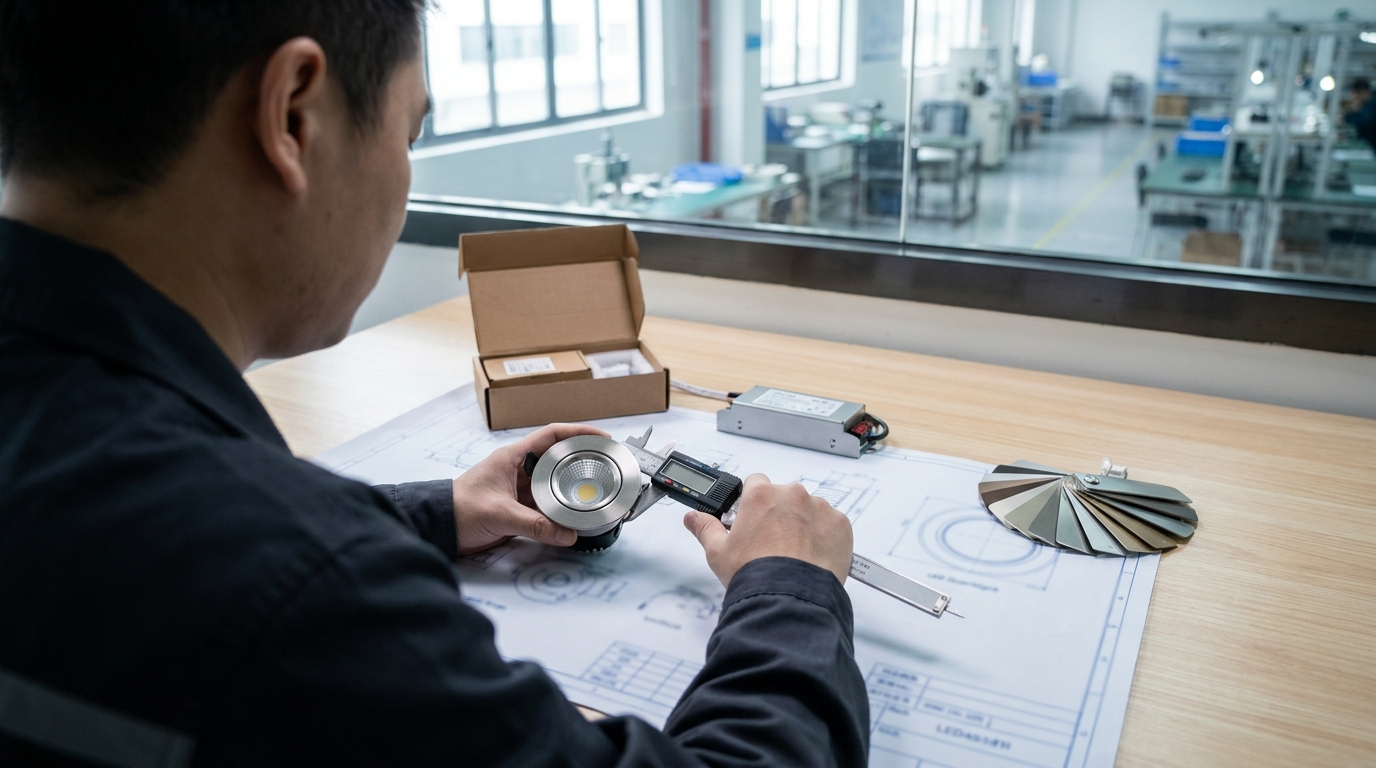
- Product and BOM: Identify the LED chip and driver by brand, model or agreed equivalent. Specify housing material and finish, lens or reflector, wiring, connectors, mounting hardware and included accessories. Ask what is replaceable and whether substitutions require approval.
- Lighting performance: Request luminous flux for the complete fixture, not the LED chip alone. Compare lumens per watt, CCT tolerance, CRI, SDCM, flicker, beam angle, power factor and THD under the same voltage and test conditions. For project lighting, request photometric data or an IES file where relevant.
- Commercial terms: Separate the MOQ for the standard product, custom specification and printed packaging. Record sample charges, tooling or mold fees, certification costs, production time and replenishment lead time. Confirm whether the quotation covers packaging, inspection, freight or only the finished product.
- Manufacturing control: Ask what happens inside the factory and what is outsourced. Find out how BOM revisions are recorded and how unapproved substitutions are prevented. For custom orders, retain an approved or Golden Sample with a written specification. Agree inspection points, defect handling, rework and approval of corrected units in advance.
Two quotations are not comparable until they describe the same specification, components, packaging, testing and delivery terms. A cheaper number may simply be pricing a different product.
What Certifications Do LED Lights from China Need?
There is no universal certificate for every LED light. Requirements depend on the product, destination market, installation and sales channel.
For Europe, CE marking means the manufacturer declares conformity with applicable EU requirements; it should not automatically be described as a third-party certificate. RoHS concerns restricted substances in electrical and electronic equipment. ENEC is a voluntary third-party safety mark used for certain European electrical products.
For North America, UL and ETL are product-safety certification marks issued through recognized testing organizations. An ETL-certified product may be evaluated against UL standards, but “tested to UL standards” is not the same as being UL Listed. Check the certification database, covered model, manufacturer and production location.
The CB Scheme can support international acceptance of IEC-based test results, though local market requirements may still apply. SAA approvals are relevant to Australia; applicable registration and RCM obligations should also be confirmed.
Some documents describe performance rather than market approval. LM-79 covers photometric and electrical measurements of complete lighting products. LM-80 measures lumen maintenance for LED packages or modules, not the lifetime of a finished luminaire. IP rates protection against dust and water; IK addresses mechanical impact. An IES file contains light-distribution data for lighting design. It is not a certificate.
A supplier’s certification portfolio is useful qualification evidence, but every product needs the applicable approval and supporting documents. Check the holder, exact model, standard and status. Changes to the driver, wattage, housing or structure may affect coverage. FFOrder’s promoted lighting products carry CE documentation, and the team can collect product-level files or coordinate additional requirements. Market access must still be confirmed for the chosen product and destination.
Order Samples Before Bulk Production
A lighting sample should answer more than “does it turn on?” Compare it with the product page, drawing and written specification. Check dimensions, colour, finish, paintwork, welds, joints and overall structure. Test light output, brightness, colour temperature, visible flicker, switches, wiring and connectors. Confirm that mounting parts, screws, drivers, remotes and other accessories are present.
Then install it. A fixture that looks fine on a table can still be awkward or unsafe to assemble. Verify the plug, input voltage, labels and instructions for the destination market. Open the parcel as a customer would. Loose parts, thin protection and supplier branding are easier to correct before production than after arrival.
For custom products, keep the sequence clear:
Written specification → Factory sample → Buyer approval → Bulk production → Inspection against the approved sample
A Golden Sample can anchor that comparison, but the role should be agreed per project. Decide whether it needs signing, remains at the factory or serves as the warehouse inspection reference.
Piece-by-Piece Inspection for Lighting Products
A light can work and still be unsellable: chipped paint, a bent frame, missing screws, the wrong plug, inconsistent colour or packaging that differs from the approved order. These are easy to miss when inspection only covers a small sample.

FFOrder inspects every lighting SKU piece by piece. The checklist is defined around the fixture, approved requirements, likely failure points and destination-market needs. Depending on the product, inspection may cover:
- Scratches, exposed base material, paint loss, deformation, cracks and loose joints;
- Basic power-on testing, switches, wiring, connectors and visible flicker;
- Dimensions, housing colour, finish, labels and SKU information;
- Screws, mounting hardware, drivers, remotes and other included accessories;
- Plug type, printed instructions, warning labels and packaging language;
- Inner protection, carton condition, barcode placement and packed quantity.
The approved sample and written specification are the reference point. Failed units should be separated rather than put back into sellable inventory. Whether the next step is rework, replacement or rejection depends on the defect standard agreed for that order.
There are limits to warehouse inspection. It can confirm appearance, basic operation, accessories and packaging; it cannot replace laboratory testing. Electrical safety, photometric performance, IP/IK ratings, EMC, material compliance and certification claims require the relevant reports and market-access process.
Packaging Fragile and Oversized Lighting Products
A carton suitable for a compact wall light may not survive a pendant fixture or large ceiling lamp. These products combine fragile shades, exposed frames, irregular forms and loose accessories. Damage often begins at an obvious weak point: the edge of a frame, a shade corner, a projecting arm or an unsupported gap inside the box.
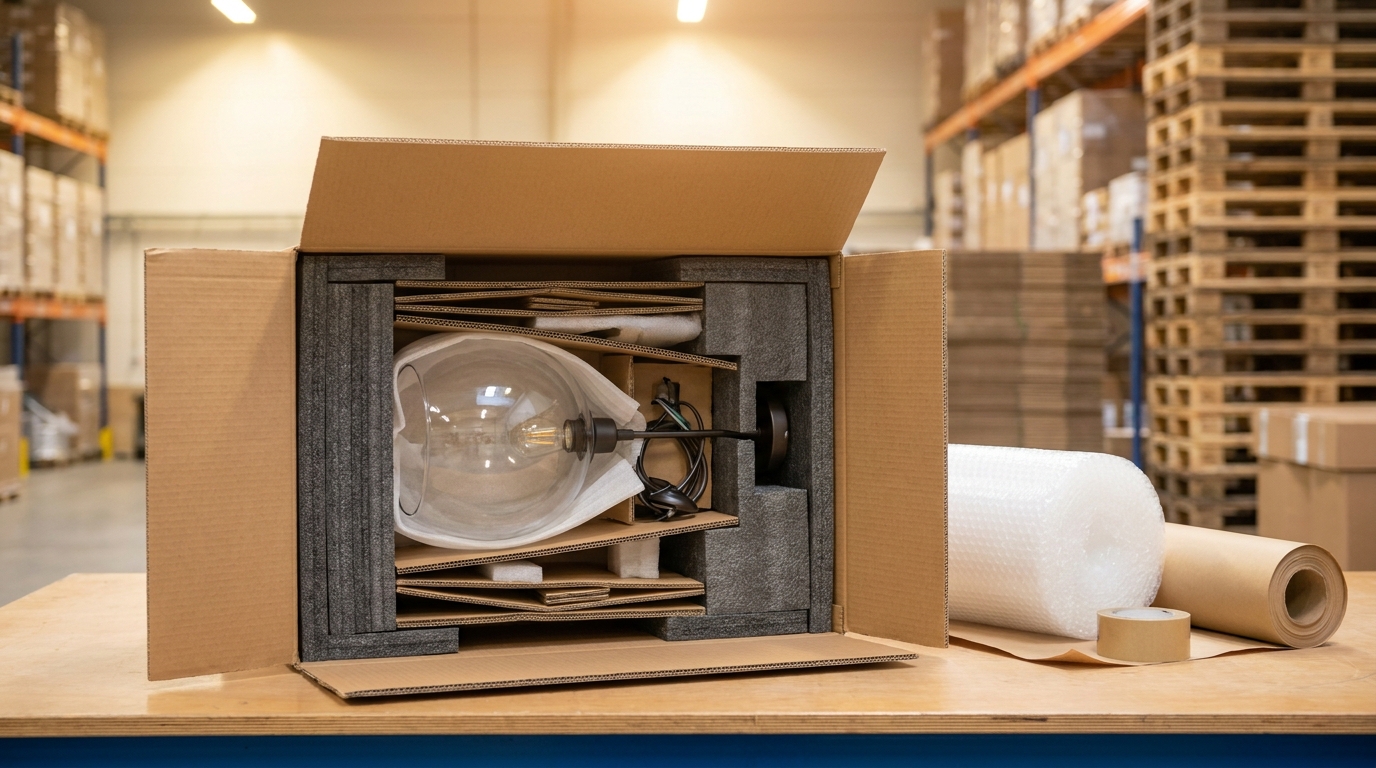
Packaging should follow the product’s structure. Fitted foam, edge strips, corner guards, reinforced corrugated cartons, air columns or wooden reinforcement may be appropriate, depending on weight, value, shape, route and likely impact points. Delicate surfaces also need separation from foam, metal parts and accessories that could rub against the finish in transit.
Screws, bulbs, remotes, mounting plates and other accessories should be sealed separately, labelled and fixed inside the package. If they move freely, they can scratch the fixture or go missing. Multiple fixtures in one carton need rigid separation so they cannot collide. Fill empty space without putting damaging pressure on shades or decorative parts.
FFOrder develops packaging around the product’s weak points rather than applying one carton standard to every lamp. The team can review the fixture, identify vulnerable areas, coordinate protection and check the finished package before it enters inventory or fulfillment.
Protection also changes shipping economics. More foam, thicker cartons, corner guards or a wooden frame can increase external dimensions and chargeable weight. Recalculate volumetric weight after the final package is approved, not from the original product carton. For unfamiliar or high-value fixtures, a packed sample and real shipping test can show whether the protection is adequate before a larger order moves.
For an example of how product presentation and protection can be coordinated, read our Lighting Branding Case Study: From Sourcing to Custom Packaging.
China’s Main Lighting Manufacturing Hubs
China’s lighting industry is spread across several clusters. Zhongshan’s Guzhen area is a major centre for decorative lighting, with manufacturers, component suppliers, showrooms and wholesale markets across the surrounding towns. It is a sensible starting point for pendants, ceiling fixtures and other decorative products.
Shenzhen is more relevant for LED strips, drivers, electronic controls and smart-lighting hardware. Xiamen has manufacturers working across connected lighting and IoT devices, including bulbs, sensors and control systems. Hangzhou and other parts of Zhejiang are worth considering for street lighting, floodlights, industrial fixtures and project-based outdoor products.
A cluster narrows the search. It does not qualify a factory. Buyers still need to confirm the legal entity, product scope, manufacturing ownership, certifications, samples and quality control. Guzhen is not automatically the cheapest source, and a Shenzhen address does not prove stronger technology.
When to Use FFOrder Instead of Managing Factories Directly
Working directly with one factory can be efficient when the specification is clear, volume is stable and the buyer has people managing production and quality. It can also work when one supplier covers the range and the buyer can handle packaging, inventory, freight and after-sales issues without outside coordination.
The workload changes when pendants, wall lamps, LED strips or smart fixtures come from different factories. Each may have its own sample, BOM, certification files, packaging method and replenishment schedule. OEM and ODM work adds decisions on materials, finishes, labels, instructions and approved production standards. Fragile, oversized and irregular fixtures need packaging that accounts for their real weak points.
FFOrder acts as the operating layer between those factories and the ecommerce business. It can coordinate supplier matching, samples, written requirements, OEM/ODM work, piece-by-piece inspection, protective packaging, private inventory and international fulfillment under one workflow. The standard delivery window for Europe is 7–9 days. Refunds, reshipments or cost coverage are assessed against the evidence, responsibility and applicable service terms.
FAQ
1、Who is the best LED lighting manufacturer in China?
There is no single best manufacturer for every product. OPPLE covers broad residential and commercial ranges; LEEDARSON focuses on connected lighting, ZGSM on outdoor projects and LEDYi on strips. The right choice depends on the specification, target market, order size and required customization.
2、Where are most LED lights manufactured in China?
China has several lighting clusters. Zhongshan and Guzhen are strongly associated with decorative fixtures. Shenzhen has many strip-lighting, electronics and smart-device suppliers; Xiamen has connected-lighting manufacturers; Zhejiang includes outdoor and project-lighting companies. Location helps narrow a search, but it does not prove factory quality.
3、What is the MOQ for custom LED lighting?
MOQ depends on the product, factory, materials, tooling, packaging and degree of customization. A logo may require fewer units than a new housing or electronic design. Ask separately for product MOQ, custom-component MOQ, printed-packaging MOQ and any minimum spend. FFOrder evaluates MOQ against the customer’s actual requirements.
4、Do Chinese LED manufacturers provide CE, UL or ETL products?
Many do, but coverage varies by model. A factory displaying CE, UL or ETL information does not mean every product is covered. Request the certificate or declaration, holder name, model number, applicable standard and current status. Changes to the driver, wattage, housing or structure may affect coverage.
5、How do I verify an LED lighting factory?
Check the registered company, factory address, product focus, production processes and export experience. Ask what is completed in-house and what is outsourced. Review product-level documents, order samples and inspect production. A marketplace verification badge or polished showroom is a starting point, not final proof.
6、Should I order samples before bulk production?
Yes. Test appearance, dimensions, finish, light output, colour temperature, wiring, controls, accessories, installation and packaging. For custom products, approve the sample against a written specification and decide whether it becomes the Golden Sample used by the factory or inspection team during bulk production.
7、Can Chinese manufacturers produce private-label lighting?
Many can, but the scope ranges from applying a logo to developing a new structure or electronic design. Confirm what can change, who owns drawings and molds, and whether certification remains valid. Quote product, component, packaging and customization MOQs separately.
8、How do I reduce damage when shipping lighting from China?
Design packaging around the fixture’s weak points. Depending on the product, that may mean fitted foam, corner protection, reinforced cartons, separated accessory bags, internal dividers or wooden reinforcement. FFOrder can coordinate product-specific packaging and inspection, but final dimensions and volumetric shipping weight should be recalculated before dispatch.
FFOrder Team
FFOrder helps growing brands run dropshipping and fulfillment as one system — from sourcing across 40,000+ factories to global shipping and structured after-sales.
Source LED Lighting from China with More Control
FFOrder helps ecommerce brands and project buyers coordinate lighting supplier matching, samples, piece-by-piece inspection, protective packaging, private inventory and international fulfillment in one workflow.

-1200x628%20(14).png)