
CJdropshipping Alternative in 2026: FFOrder vs CJdropshipping
CJdropshipping Alternative: FFOrder vs CJdropshipping

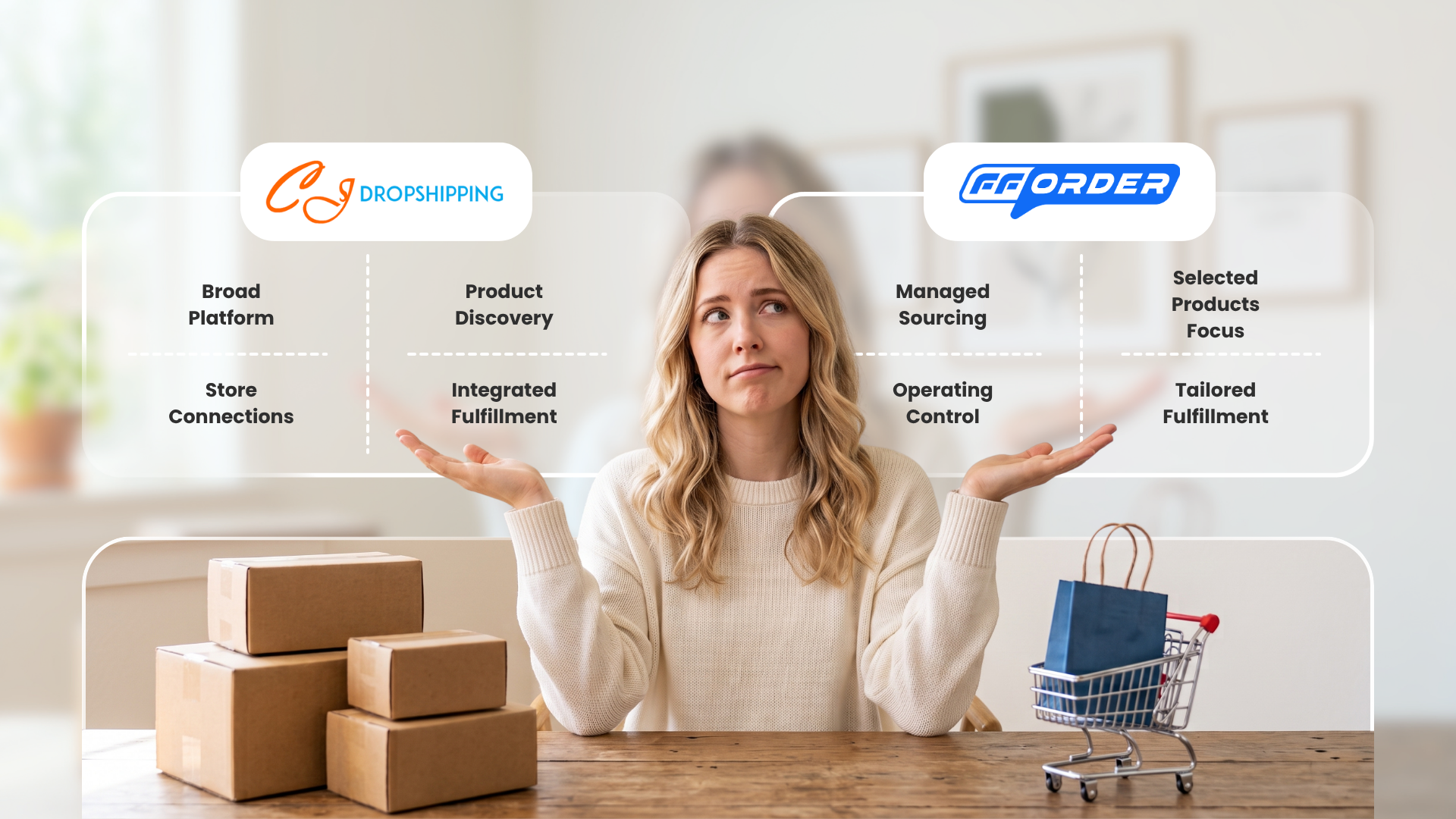
Stay with CJdropshipping when its catalog, sourcing requests, integrations, and per-order fulfillment already support the business.
Consider FFOrder when proven products need approved samples, written specifications, product-specific QC, planned inventory, packaging rules, and clearer exception ownership.
Move selected SKUs rather than migrating the entire catalog, and test the complete order and tracking loop before increasing volume.
CJdropshipping Is Useful—and Often Worth Keeping
CJ’s appeal is straightforward. Its service overview puts product discovery, sourcing requests, listings, order synchronization, inspection, inventory, warehouses, packaging, POD, and fulfillment in one place. That is a practical setup when a seller is still testing products or does not want a separate supplier and logistics process for every listing.
Core access has no setup or monthly membership fee. “Free platform” is still an incomplete description: products, shipping, private inventory, storage, packaging, sourcing, and selected processing services can all create charges. CJ’s service-fee schedule is the better reference when real costs matter.
The platform also connects with several ecommerce systems. The list changes, so check CJ’s current compatible-platform documentation instead of relying on an old integration count.
There is little reason to disrupt a stable setup. CJ is usually the sensible choice when:
- You are still testing several products and use its catalog or sourcing requests heavily.
- Listing, order sync, tracking, and after-sales cases already move cleanly.
- CJ’s inspection, warehouse, POD, inventory, and packaging options fit the products.
- Private stock or packaging materials are already tied to a CJ warehouse.
- The operational gain from switching is smaller than the work of resampling, remapping SKUs, reconciling stock, and running a cutover.
A provider does not have to fail before another model becomes relevant. Sometimes the product simply outgrows the workflow that helped launch it.
Where the Comparison Starts to Matter
The SKU Has Stopped Being a Test
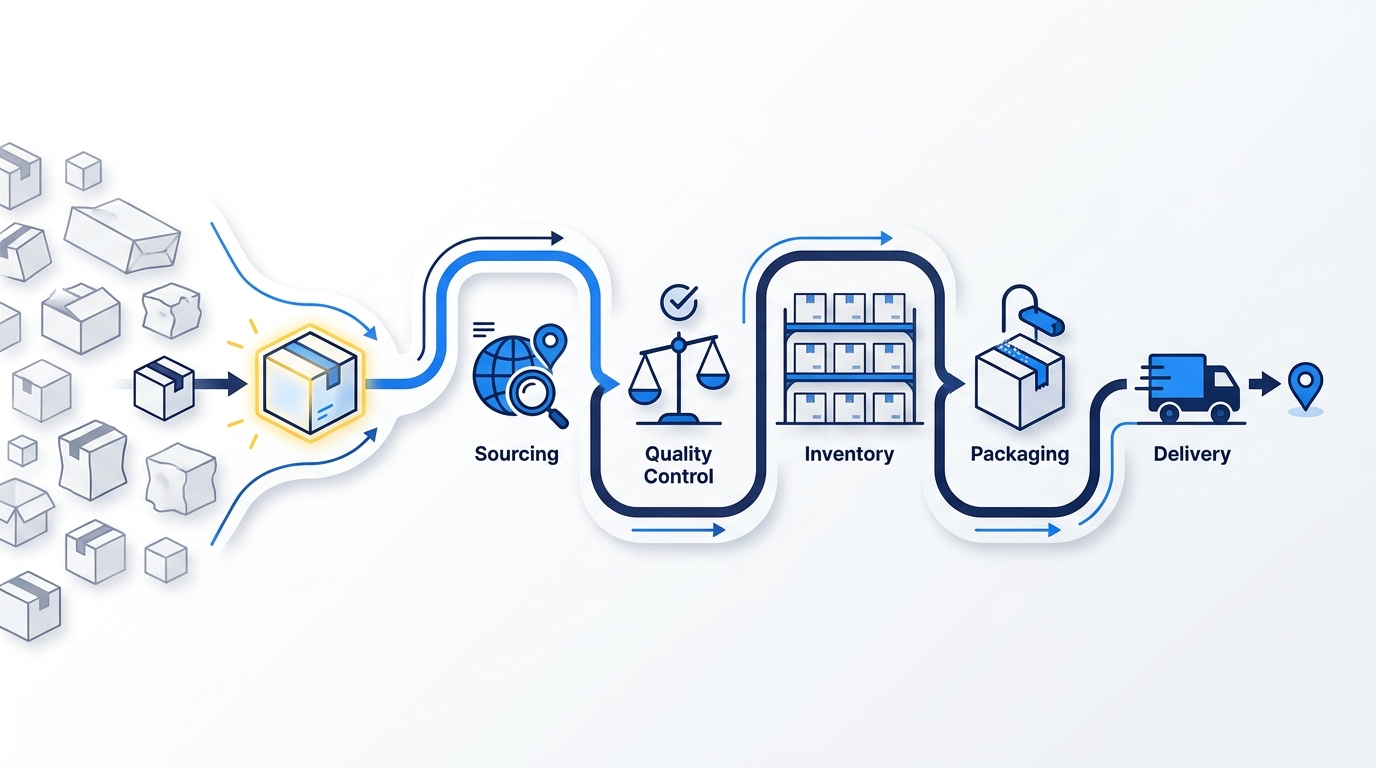
A large catalog is valuable while demand is uncertain. Once the same item is reordered every week, access is no longer the main issue. The questions become more exact: Which factory version is approved? Are the material, dimensions, and accessories fixed? Which package belongs to each variant? When should the next batch be purchased?
At that point, another product listing is less useful than a repeatable product definition.
QC Needs a Product-Level Standard
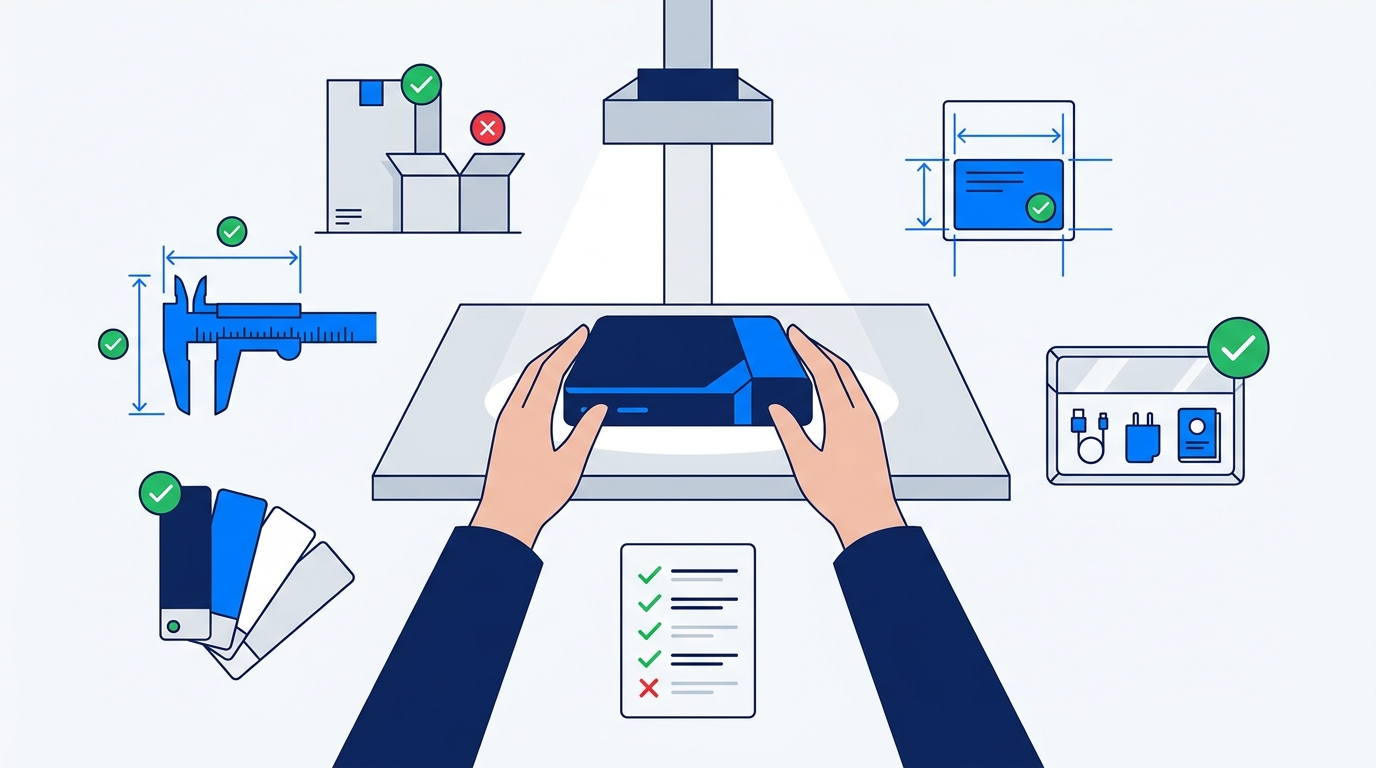
CJ already inspects products. Its quality-inspection guidance says products shipped through CJ are checked before dispatch, with separate terms for service products supplied from outside CJ.
The gap appears when “check the product” is too broad. A stable SKU may need written pass/fail rules for color, measurements, function, accessory count, label placement, or packaging. A general inspection can catch obvious damage. It may not protect a detail that matters only to this product and its customers.
Product Stock and Packaging Stock Affect Each Other
CJ supports private inventory, POD, and custom packaging. The operational questions remain: Where is each item stored? Is the correct packaging in the same warehouse? Which variant uses which insert? What happens when the box runs out before the product does?
CJ’s custom-packaging page says some options can start from one unit. That should not be read as a universal one-unit MOQ for every printed format. The actual minimum depends on the packaging selected. FFOrder’s pages also use different MOQ language across its services, so product, private-inventory, POD, and packaging minimums should be confirmed in the written quote.
One Exception Can Cross Four Teams
CJ has agents, disputes, refunds, resends, returns, and formal support procedures. The problem is not the absence of support. It is ownership when a case touches the factory, warehouse, carrier, and after-sales process at the same time.
Some sellers are comfortable managing those handoffs inside a platform. Others want one operating team to keep the case until the next action—and the final outcome—are clear.
An Integration Must Complete the Whole Loop
Importing an order is only one part of the connection. Inventory must stay aligned. Tracking has to return to the store. Cancellations, variants, bundles, and exceptions need a defined path too.
FFOrder’s integration page currently lists Shopify, WooCommerce, TikTok Shop, CartPanda, Yampi, Nuvemshop, Dropi, and a developer API. It describes order import, SKU mapping, inventory synchronization, tracking write-back, and structured exception handling. The relevant test is not the number of logos on the page. It is whether the exact store and order flow work from end to end.
What FFOrder Adds After a Product Is Selected

FFOrder can start from an existing SKU, a sourcing request, or its own product-discovery resources. The difference becomes clearer after product selection. Its managed workflow can cover factory sourcing, supplier comparison, samples, written specifications, product-specific QC, private inventory, replenishment, custom packaging, warehousing, 3PL fulfillment, print-on-demand, OEM, ODM, and after-sales coordination.
For a proven product, that can turn several loose instructions into one working set of references:
- The approved sample defines the version being purchased.
- Written specifications capture details that should not change silently.
- QC points focus on the defects or variations that matter for that SKU.
- Replenishment, product stock, and packaging stock are planned together.
- One operating team coordinates physical exceptions across the supplier, warehouse, carrier, and after-sales case.
FFOrder’s official FAQ says there is no platform or membership fee. The physical operation is still paid: products, production, inventory, packaging, storage, shipping, and selected services are quoted around the work required. Public FFOrder pages do not use one consistent MOQ rule across every service, so the defensible wording is simple: a product- or service-specific MOQ may apply. Confirm it in the quote.
This is not automatically a better model for every listing. It is most useful when a smaller group of products needs repeatable execution and someone clearly responsible for the physical workflow.
CJdropshipping vs FFOrder at a Glance
Price comparison is simple in theory and tedious in practice. Use the same SKU, variant, quantity, packed weight and dimensions, warehouse origin, destination, packaging, and shipping service. If any of those inputs changes, the quote is no longer comparable. A signup price will not settle the question.
What Changes When FFOrder Takes Over a SKU
A Product Title Becomes a Sourcing Brief
CJ makes it easy to begin with a catalog listing or a sourcing request. In an FFOrder-managed workflow, supplier selection can follow a tighter brief: materials, dimensions, components, finish, target cost, packaging, and destination-market requirements.
The gain is not access to “more suppliers.” It is asking different suppliers to quote the same product definition.
The Approved Sample Becomes a Working Reference
A sample has limited value if the next production run is allowed to drift. FFOrder can use the approved sample, written specifications, and agreed inspection points as references for sourcing, inbound checks, packaging, and fulfillment.
Small differences are often the ones that create returns: a shade change, a missing accessory, a loose connection, the wrong label position. The product title may stay identical while the customer experience does not.
Inventory, Packaging, and Replenishment Share One Plan
CJ already offers private inventory and packaging. FFOrder’s stronger use case is coordinating those pieces around a selected SKU: when stock is purchased, where it sits, when packaging is replenished, and which packing rule applies to each variant.
That can remove unnecessary handoffs. It does not remove the commercial risk of holding inventory, and it should not be used as an excuse to buy stock before demand is clear.
Physical Exceptions Stay With One Operating Team
A lost parcel is usually a carrier case. A wrong production batch is not. It may involve the factory, inspection record, warehouse stock, orders already shipped, and an after-sales decision.
FFOrder’s model is designed to coordinate those parties through one operating team. The standard to test is concrete: when something goes wrong, does one owner remain responsible for the next action until the case closes?
The Integration Is Tested as a Loop, Not a Login
FFOrder publishes workflows for importing orders, mapping SKUs, synchronizing inventory, returning tracking, and handling exceptions. Those capabilities still need testing with the store’s real variants, bundles, cancellations, refunds, and reships.
A successful authorization screen proves that the accounts are connected. It does not prove that the operation works.
When CJdropshipping Is Still the Better Choice
Stay with CJ when:
- The product has not shown stable demand.
- You want to test several listings without first building a detailed sourcing brief.
- Your workflow depends on CJ’s catalog, sourcing requests, listing tools, or current warehouse setup.
- Its inspection, inventory, packaging, and fulfillment already meet the product’s requirements.
- The volume does not justify product-specific production or inventory planning.
- Open orders, disputes, private stock, or packaging would make a move more expensive than the problem being fixed.
Switching because another provider has a feature that CJ also offers is not a strategy. There should be a specific constraint, a better operating design, and a way to verify the improvement.
Which Model Fits the Product Stage?
The decision does not have to cover the whole catalog. CJ can remain the testing workflow while FFOrder handles a smaller set of proven products.
Can CJdropshipping and FFOrder Run Together?
Yes—but not as one native system. There is no documented direct connection between the two providers; each uses its own supported store workflow.
Keep the split unambiguous:
- By SKU: CJ receives the products assigned to CJ; FFOrder receives the products assigned to FFOrder.
- By timestamp: CJ finishes orders placed before a fixed cutoff; FFOrder receives orders placed after it.
Put the provider, supplier SKU, warehouse, shipping rule, and cutoff in the product map. Product titles and staff memory are not reliable controls.
How to Move Selected Products from CJdropshipping to FFOrder

Do not start by disconnecting CJ. Start by deciding what CJ still owns.
1、Audit Open Orders and After-Sales Cases
Export every unresolved order. Keep the store order number, CJ order number, SKU, variant, warehouse, payment status, fulfillment status, tracking number, and current owner in one file.
Track refunds, reships, returns, disputes, and chargebacks separately. CJ handles eligible cases under its refund, resend, and return policy. Unless responsibility changes in writing, the cleanest approach is for CJ to finish orders already paid or in process through CJ.
2、Confirm Inventory Ownership and Warehouse Status
Request a written stock statement by SKU and warehouse. It should separate available units, stock reserved for open orders, and remaining packaging materials.
CJ’s private-inventory purchase guide explains how stock is bought and used within CJ. Its private-inventory refund guidance covers cancellation and refund requests, but does not promise a refund for paid inventory. Unpaid orders can be cancelled; paid requests go through CJ’s dispute and case-review process.
The official pages reviewed do not describe a standard or guaranteed right to send private inventory or packaging to another provider. CJ’s 3PL pricing page uses the formula shipping fee + inbound fee + outbound fee + stocking fee, and its service-fee schedule lists warehouse-specific reference charges. Neither is an all-in quote for an external stock transfer. Get the release options and charges in writing before building the migration around inventory moving.
3、Document the Product Properly
Create one handoff file per SKU. Include store and CJ SKUs, variants, bundles, pack sizes, supplier links, approved images or specifications, packed dimensions, labels, inserts, barcodes, packaging files, destination countries, and shipping services.
CJ maps products at variant level. Its variant-connection guidance shows why this matters. Two variants can look similar on the storefront and still require different warehouse mappings.
4、Quote, Sample, Map, and Test
Ask FFOrder to quote the same product, quantity, packed dimensions, warehouse origin, destination, packaging, and shipping service. Approve the physical sample before buying stock or sending live volume.
Map every active variant and bundle. Then test order import, address transfer, inventory deduction, cancellation, tracking write-back, refund, and reship. Do not treat store authorization as a completed test.
5、Cut Over by SKU or Timestamp
Choose one rule and use it everywhere. CJ can finish orders placed before a fixed timestamp while FFOrder receives later orders, or the providers can own separate SKU groups.
A short parallel period can help. Two providers fulfilling the same order cannot.
A controlled cutover reduces the chance of disruption. It cannot guarantee zero downtime.
CJdropshipping Alternative FAQ
Is FFOrder Better Than CJdropshipping?
For every seller and every product? No. FFOrder is the stronger fit when a selected SKU needs an approved sample, written specifications, product-specific QC, planned inventory, packaging rules, and one team coordinating physical exceptions. CJ may be the better option when the business relies on its catalog, listing tools, sourcing requests, warehouse setup, and established order workflow.
Is CJdropshipping Still Worth Using?
Yes. CJ still combines catalog-led testing, sourcing requests, store authorization, order synchronization, inspection, warehouses, private inventory, packaging, POD, and fulfillment. If those parts work for the products being sold, replacing them adds risk without solving a clear problem. Keep CJ until a specific SKU or process gives you a reason to change.
Is FFOrder Cheaper Than CJdropshipping?
There is no verified universal answer. Compare the same SKU, variant, quantity, packed dimensions, warehouse origin, destination, packaging, and shipping service. Both providers separate platform access from physical costs such as products, freight, storage, packaging, and selected services. Change one input and the landed-cost comparison changes with it.
Can FFOrder Replace CJdropshipping Completely?
Not as a like-for-like replacement for every workflow. FFOrder also provides sourcing and product-discovery resources, but its catalog, listing tools, store connections, warehouse processes, and after-sales procedures differ from CJ’s. Review the exact workflow product by product. Move the SKUs that benefit from FFOrder’s managed model; leave the rest where they work.
Can I Move Private Inventory from CJdropshipping to FFOrder?
Do not assume so. The official CJ pages reviewed do not describe a standard external-transfer process or guarantee that private inventory or packaging will be released to another provider. They also do not provide an all-in transfer price. Ask CJ to confirm the stock balance, ownership, warehouse, release options, and every applicable charge in writing.
Can CJdropshipping and FFOrder Run at the Same Time?
Yes, provided order ownership is explicit. Split the work by SKU or by a fixed order timestamp, and make sure each provider receives only the orders assigned to it. Test cancellations, tracking, refunds, and reships before moving volume. Without that boundary, a mixed setup can create duplicate fulfillment—or leave an order with no owner at all.
Final Verdict
The dividing line is not company size. It is product maturity.
CJdropshipping is usually the better fit while the business is discovering products, submitting sourcing requests, and testing demand through a broad platform workflow. FFOrder makes more sense when a proven or clearly specified SKU needs tighter control over sourcing, samples, specifications, QC, replenishment, packaging, integrations, and physical exceptions.
Do not migrate a catalog to make the comparison look decisive. Start with one product that has a real operating problem. Match the quote inputs. Approve the sample. Test the complete order loop. If the new workflow holds up, move more volume. If it does not, you have limited the risk to one SKU.
FFOrder Team
FFOrder helps growing brands run dropshipping and fulfillment as one system — from sourcing across 40,000+ factories to global shipping and structured after-sales.
Ready to Improve Your Sourcing and Fulfillment?
Share your products, target markets, order volume, inventory position, packaging requirements, and current fulfillment challenges with FFOrder.

-1200x628%20(14).png)