
3 Best AutoDS Alternatives in 2026
Compare DSers, CJdropshipping, and FFOrder by cost, automation, sourcing, quality control, inventory, branding, and fulfillment.

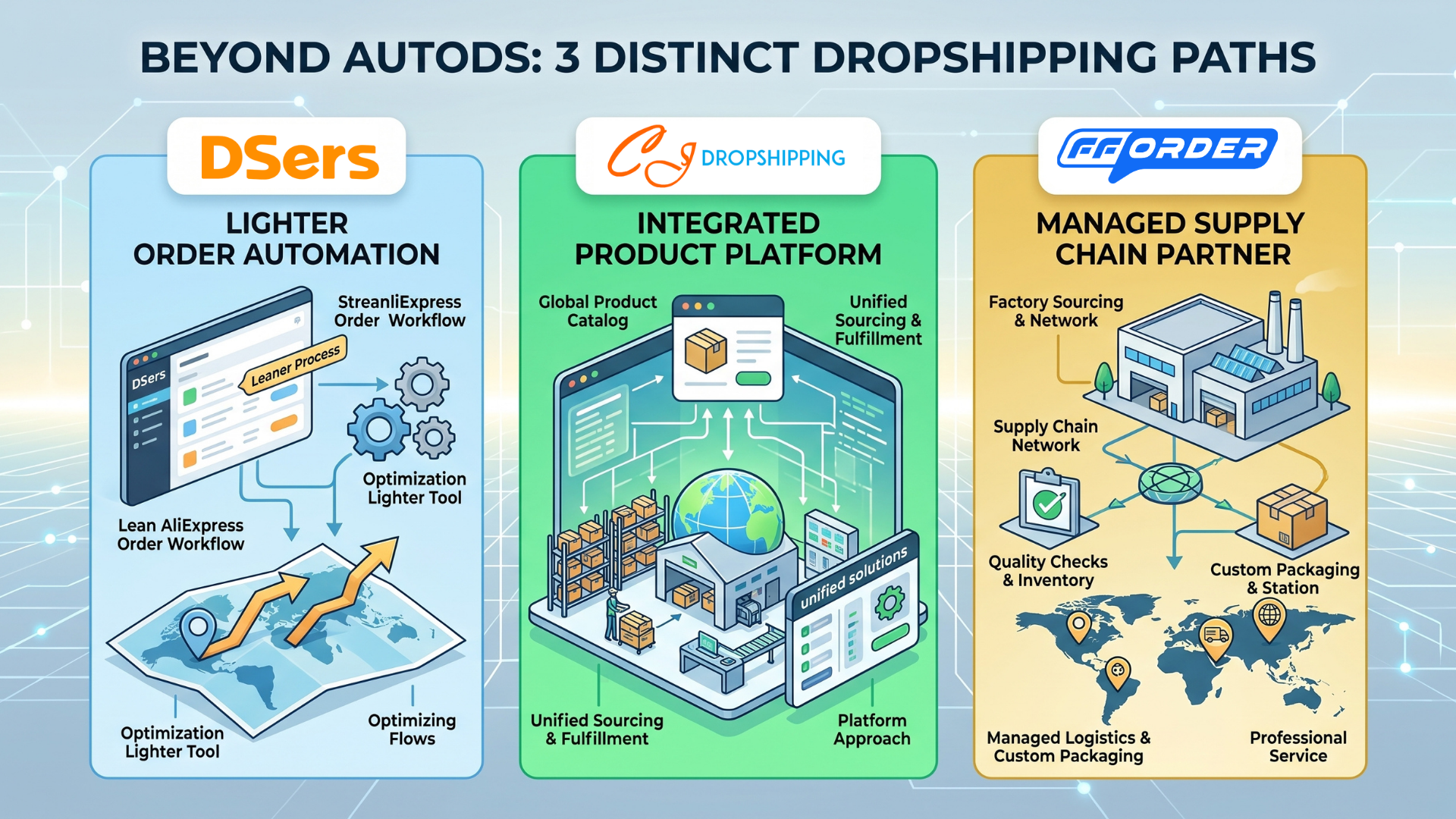
DSers is best for AliExpress importing, supplier mapping, bulk ordering, and a leaner order-management workflow.
CJdropshipping is best for sellers who want product sourcing, catalog access, warehousing, and fulfillment in one platform.
FFOrder is best for validated products that need managed factory sourcing, product-specific QC, private inventory, branded packaging, and fulfillment.
Keep AutoDS if product research, multi-supplier monitoring, repricing, listing management, and multi-channel automation are still important to your business.
Compare total landed cost—not only subscriptions or product prices—including shipping, warehousing, packaging, duties, customization, and service fees.
What AutoDS Does Well—and When to Keep It
AutoDS handles product imports, supplier price and stock monitoring, order processing, tracking updates, and store management from one dashboard. Its supported selling channels include Shopify, eBay, Amazon, Etsy, TikTok Shop, Wix, WooCommerce, and Facebook, although the available automation depends on the channel, supplier, plan, and fulfillment method.
Its value is clearest when the catalog is broad and repetitive store work is consuming time. Sellers can use AutoDS’s product importing tools and API automation to work across suppliers, apply pricing and inventory rules, process orders, and keep listings current without checking every store by hand.
Keep AutoDS if:
- You are still testing products across several suppliers.
- Price, stock, and listing updates are the main operational burden.
- You manage several stores or support sales channels.
- You still rely on its research, monitoring, or listing tools.
A different provider becomes more relevant when the work is no longer mainly about listings and orders. A stable SKU may need an approved sample, written specifications, repeatable QC, private inventory, branded packaging, or one team to coordinate fulfillment. That is a different operating problem—not proof that AutoDS has stopped working.
Why Sellers Compare AutoDS Alternatives
The Software Cost No Longer Matches the Workflow
AutoDS pricing varies by selling channel and listing allowance. Separate subscriptions may be required for different channels, and some functions are add-ons. According to AutoDS’s plan overview and billing guide, plans cover 200–10,000 listings and the Orders Processor costs another $9.90 per month. Compare the channels, stores, and features you actually use—not the trial price.
The Supplier Workflow Is Too Broad—or Not Controlled Enough
AutoDS already works with a network of global retail, private, and internal suppliers, including sourcing and warehouse options. The issue is usually fit. An AliExpress-led store may want a simpler order workflow. A seller that wants products, sourcing, and fulfillment under one platform may prefer CJdropshipping. A repeat-selling SKU may need direct factory coordination and tighter operating control.
Product Quality Needs a Written Standard
The AutoDS FAQ says selected sourcing and warehouse services can include quality checks and pre-shipment inspection, so saying the platform has no QC would be inaccurate. The gap appears when a product needs an approved sample, defined specifications, batch-level checks, and clear pass/fail rules.
One Team Needs to Own Physical Exceptions
AutoDS documents workflows for failed orders, address errors, and returns in its order troubleshooting guide, with separate documentation for Fulfilled by AutoDS. Some businesses still want one operating contact to coordinate suppliers, warehouses, carriers, and after-sales cases. The distinction is not human support versus no support. It is who follows a physical problem through to resolution.
How This Comparison Was Built
The comparison covers four practical layers:
- Cost and access: subscriptions, add-ons, service fees, and product limits
- Software workflow: importing, supplier mapping, monitoring, orders, tracking, and integrations
- Physical operations: samples, QC, inventory, warehousing, packaging, POD, OEM, and ODM
- Operating ownership: who handles stockouts, mapping errors, shipping losses, returns, and quality issues
Product cost and delivery performance still depend on the SKU, weight, warehouse, destination, service level, and carrier. A valid comparison uses the same item, route, and service conditions. Without that, “cheaper” and “faster” are not useful conclusions.
AutoDS vs DSers vs CJdropshipping vs FFOrder
AutoDS is included as the baseline and is not counted among the three alternatives.
Pricing and capabilities were checked against official provider pages on August 19, 2026. Unless stated otherwise, platform fees exclude products, shipping, warehousing, customization, duties, and taxes.
The choice is less complicated than a long vendor list suggests. DSers removes software overhead from an AliExpress-heavy workflow. CJdropshipping moves sourcing and fulfillment into one platform. FFOrder is for sellers that need more direct control over the physical supply chain behind selected products.
The 3 Best AutoDS Alternatives in 2026
1. DSers — Best for a Leaner AliExpress Workflow
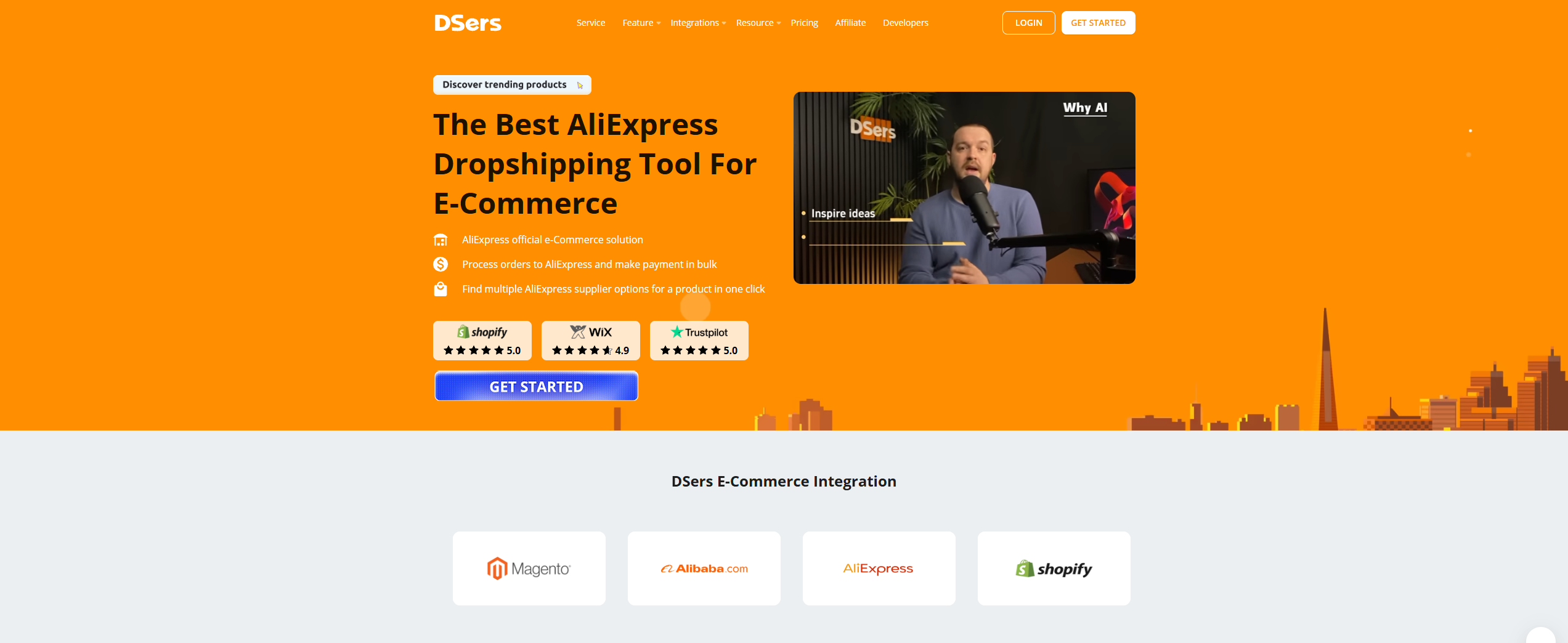
DSers is the most direct option for an AliExpress-led store that finds AutoDS broader than it needs. It covers product importing, supplier mapping, bulk ordering, tracking sync, and multi-store management. Basic access is free. Review the current DSers integrations and DSers plans and billing guide before connecting a live store.
The boundary is the physical operation. Quality, packaging, private inventory, and delivery performance still depend on the selected seller, warehouse, shipping method, or outside agency. DSers is a strong replacement for AliExpress order handling. It is not a managed fulfillment provider.
2. CJdropshipping — Best for Catalog Sourcing and Fulfillment
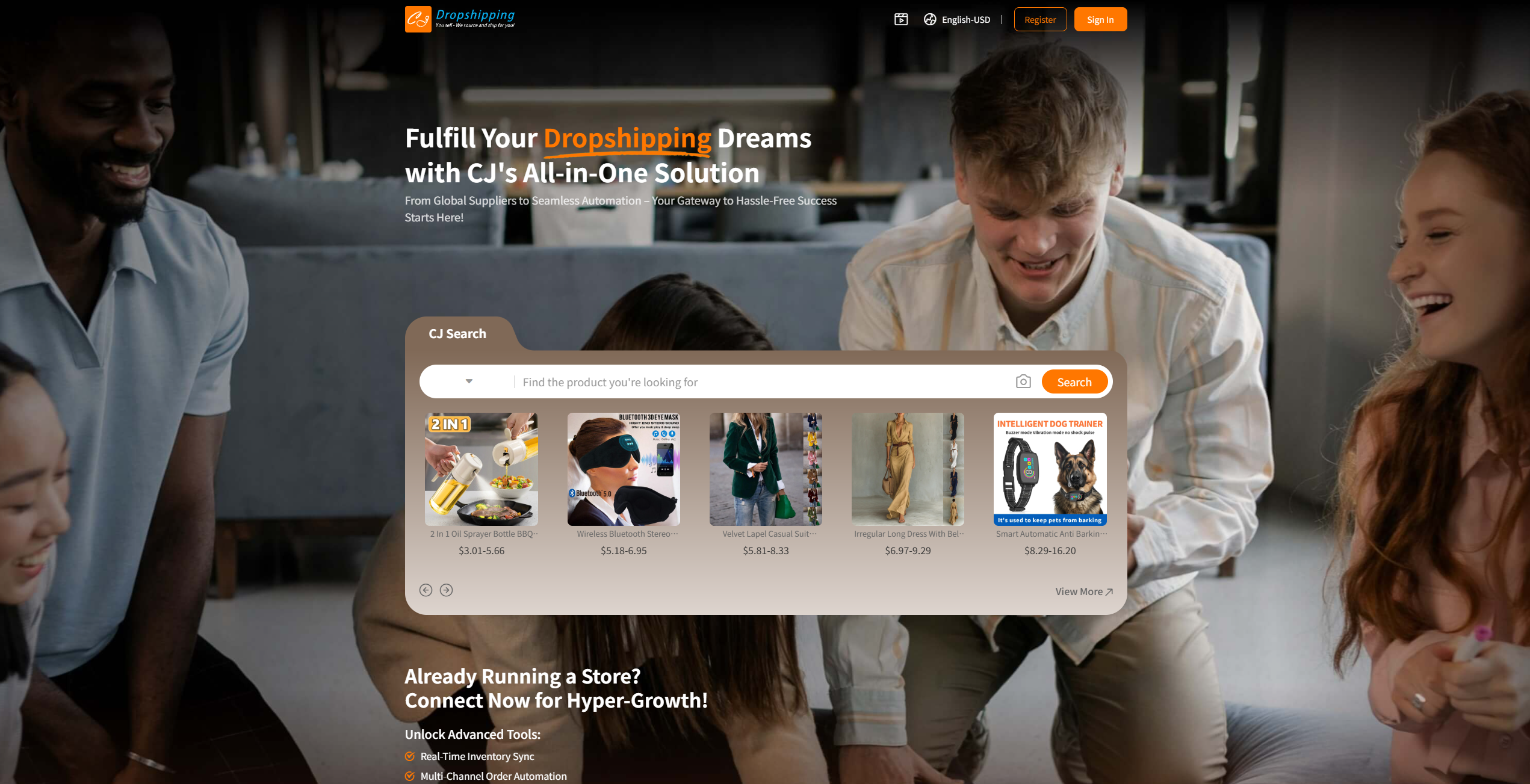
CJdropshipping combines ready-to-list products, sourcing requests, store connections, warehousing, and fulfillment. Its service overview says core access has no monthly platform fee; sellers pay for products, shipping, and applicable services. Quality inspection, private inventory, POD, and 3PL fulfillment are also available. Check the current CJ service fee schedule and custom packaging terms before moving live volume.
CJ supports multiple ecommerce integrations, but current availability should be checked for the seller’s platform and region. Its real cost is not captured by “no monthly fee.” It changes with the product, warehouse, shipping route, packaging, storage, and selected services. CJ can support product testing and stable products, but regular volume should move only after a like-for-like landed-cost comparison.
3. FFOrder — Best for Managed Sourcing and Fulfillment
FFOrder is not a product-research or listing-automation app. Its managed sourcing and fulfillment model covers factory sourcing, samples, product-specific QC, private inventory, branded packaging, fulfillment, and after-sales exceptions. Review FFOrder’s ecommerce integrations and DTC ecommerce fulfillment service for the available order, inventory, tracking, and operating workflows. The published lighting sourcing and packaging case shows quote benchmarking, specification work, protective packaging, and shipping coordination in one workflow.
The platform has no membership fee. Product and service costs are scoped around sourcing, production, warehousing, and shipping, and a product-specific MOQ may apply. Depending on the product, sellers can also review FFOrder’s custom packaging, print-on-demand, and 3PL fulfillment services. FFOrder does not replace AutoDS product research and automation, broad supplier monitoring, repricing, or listing tools.
Its strongest fit is a validated SKU—or a clearly defined sourcing, POD, or customization project—where control matters more than catalog breadth. Earlier-stage sellers can still use it for selected products, but moving a large, unproven catalog into managed sourcing would add commitment before demand is clear.
FFOrder vs AutoDS: Different Layers, Not Direct Replacements
AutoDS works mainly on the software layer. FFOrder’s supply-chain model works mainly in the physical operation behind selected products.
There is no native AutoDS–FFOrder integration. A seller can still use both by connecting each system to the store or keeping the workflows separate. SKU ownership and order routing must be explicit.
FFOrder can replace a fragmented arrangement in which the seller separately manages factory communication, inspection, warehousing, shipping, and after-sales providers. It cannot replace AutoDS’s product discovery, broad supplier monitoring, pricing rules, or marketplace listing tools. Keep an automation layer if those functions still matter.
Which Option Fits Your Business Stage?
At the testing stage, learning matters more than custom packaging or private stock. Buying inventory too early turns a weak test into an inventory problem. Once a SKU sells repeatedly, compare landed cost, samples, specifications, QC, replenishment time, packaging, and after-sales ownership—not just the listed product price.
For more context on the operational side, read FFOrder’s guides to dropshipping fulfillment and ecommerce fulfillment platforms.
How to Move from AutoDS Without Disrupting Orders
Do not disconnect AutoDS and move the whole catalog at once. AutoDS notes in its supported channels guide that listings and orders may become untracked or unmonitored when a store is disconnected and reconnected. Use a controlled cutover instead.
1. Keep Open Orders With Their Current Owner
Record the supplier, variant, status, tracking number, and any pending return or refund for each open order. The original provider should finish those orders unless responsibility is explicitly transferred.
2. Select and Document the First SKUs
Start with a small group of repeat sellers with known margins, stable specifications, and usable return data. Collect the supplier link, variant mapping, product specifications, pack size, current cost, packaging requirements, target countries, and recent order volume.
3. Compare Like for Like
Request quotes, samples, and shipping options for the same SKU, quantity, weight, destination, and service level. Approve the sample before buying inventory. A China-origin parcel quote and a warehouse-fulfilled quote are different services; the price gap is not automatically a supplier saving.
4. Map the Store and Test a Real Order
Map every variant and bundle to the correct supplier or warehouse SKU. Test order import, inventory deduction, addresses, cancellations, tracking, refunds, and reships before routing live volume. The FFOrder integrations guide documents order, inventory, tracking, and defined-exception synchronization.
5. Set a Cutover Rule and Expand Gradually
If two workflows run in parallel, divide responsibility by SKU or order timestamp. Never let two providers fulfill the same order. Increase volume only after physical stock, tracking, packaging, and after-sales handling remain stable.
Keep unproven products, unresolved orders, poorly documented variants, and inventory with unclear ownership out of the first migration batch.
AutoDS Alternatives FAQ
What Is the Best AutoDS Alternative in 2026?
It depends on what you want to replace. DSers is the closest fit for AliExpress order management. CJdropshipping combines product sourcing and fulfillment. FFOrder is more relevant when selected products need managed sourcing, QC, inventory, branding, or fulfillment.
Is There a Free Alternative to AutoDS?
DSers has a free Basic plan. CJdropshipping does not charge a monthly platform fee for core access. Sellers still pay for products, shipping, warehousing, branding, and selected services.
Which AutoDS Alternative Is Best for Shopify?
DSers fits an AliExpress-led Shopify store. CJdropshipping fits sellers who want a catalog plus sourcing and fulfillment. FFOrder fits selected Shopify products that need deeper physical supply-chain control. Keep AutoDS if broad research, monitoring, and listing automation are still useful.
Is CJdropshipping Better Than AutoDS?
Not across the board. AutoDS is primarily a multi-supplier automation platform. CJdropshipping is closer to an integrated catalog, sourcing, warehousing, QC, and fulfillment service. The better choice depends on whether the bottleneck is software automation or physical execution.
Can FFOrder Replace AutoDS Completely?
No. FFOrder can manage sourcing, samples, QC, private inventory, branded packaging, fulfillment, and after-sales coordination for selected products. It does not replace AutoDS’s ad research, product discovery, broad supplier monitoring, pricing rules, or listing management.
How Do I Switch Without Missing Orders?
Leave open orders in their current workflow. Move a small group of stable SKUs first, confirm samples and quotes, test every variant, and verify inventory, cancellations, and tracking. Route new orders only after the pilot works.
Ultimate conclusion
Keep AutoDS when catalog breadth, supplier monitoring, and listing automation are doing useful work. Choose DSers when you mainly want a leaner AliExpress order workflow. Choose CJdropshipping when you want catalog sourcing and fulfillment in one platform.
FFOrder belongs on the shortlist when the difficult work is physical: factory coordination, QC, inventory, packaging, fulfillment, and exception ownership. It is not a complete AutoDS replacement, and there is no native connection between the two. Compare the same product and route, approve a sample, test the workflow, and move volume gradually.
FFOrder Team
FFOrder helps growing brands run dropshipping and fulfillment as one system — from sourcing across 40,000+ factories to global shipping and structured after-sales.
Ready to Improve Your Sourcing and Fulfillment?
Tell FFOrder about your products, target markets, order volume, and supply-chain requirements. Compare sourcing, landed cost, quality control, inventory, packaging, and fulfillment for your selected SKUs.
-1200x628%20(14).png)