3PL vs. In-House Logistics: Which Is Right for Your Ecommerce Brand?
Compare the costs, control, technology, scalability, customization, and operational responsibilities of 3PL and in-house fulfillment.

• In-house logistics gives brands direct control over inventory, warehouse workflows, packaging, quality standards, and returns.
• A 3PL outsources storage, picking, packing, shipping, and potentially returns to a specialist fulfillment provider.
• In-house fulfillment requires investment in warehouse space, staff, equipment, systems, carrier relationships, and operational management.
• A 3PL converts some fixed logistics costs into variable service fees but may charge separately for receiving, storage, picking, packaging, returns, and special handling.
• 3PL providers may offer WMS and OMS technology, multichannel integrations, carrier rates, warehouse networks, and peak-season capacity.
• In-house logistics may be suitable for low-volume brands, highly customized products, special handling, or businesses requiring direct operational oversight.
• A 3PL may be suitable for rapidly growing brands, multichannel sellers, geographically distributed customers, and teams that want to focus on products and marketing.
• A hybrid model can keep premium, custom, or bulky products in-house while outsourcing fast-moving products to a 3PL.
• Brands should compare total fulfillment costs and service quality rather than choosing a model based only on storage or shipping prices.
• The final decision should consider order volume, SKU complexity, packaging requirements, customer locations, seasonality, systems, and growth plans.
Choosing the right fulfillment model is one of the most important decisions for an eCommerce brand. Your choice affects inventory management, operational costs, delivery speed, and most importantly, your customers’ experience.
Some brands prefer full control by managing their own warehouse, while others partner with third-party logistics (3PL) providers to scale faster and simplify operations. This guide breaks down the differences, pros, cons, and gives you a framework to choose the best model for your brand.
What Is In-House Logistics?
In-house logistics, also known as own warehouse fulfillment, means your team handles all aspects of storage, picking and packing, shipping, and returns internally. Many startups and high-value product brands choose this model because it allows maximum customization and direct oversight.
Why Some Brands Choose In-House Fulfillment
Full Control Over Inventory and Warehouse Operations
When you run your own warehouse, you have complete visibility into inventory levels and day-to-day processes. You can ensure products are handled exactly how you want—from storage conditions to packaging quality.
This level of control is especially important for premium, customized, or fragile products where small details directly impact customer satisfaction.
Customized Logistics Processes
In-house logistics also lets you build workflows that fit your brand rather than forcing your brand to fit a system. Whether you need custom packaging, unique kitting or bundling rules, special handling, or a specific return flow, you can tailor every step to match your customer experience. This level of customization can elevate the unboxing moment and strengthen long-term customer loyalty.
What Is 3PL Fulfillment?
Third-party logistics (3PL) refers to outsourcing warehousing, order fulfillment, and shipping to a professional provider. 3PL warehouses manage storage, picking, packing, shipping, and often returns, letting brands focus on marketing, product development, and growth.
Why Brands Outsource Fulfillment to 3PL Warehouses
Expertise and Technology
Outsourcing fulfillment to a 3PL means you can leverage professional expertise and cutting-edge technology. 3PL providers optimize your operations across the entire fulfillment process—from warehousing, picking, packing, shipping, to returns management. With their omnichannel systems, order fulfillment can be automated, allowing you to manage DTC and B2B sales in one place while tracking inventory in real time.
Partnering with a 3PL ensures more reliable and transparent services, helping you enhance customer satisfaction and reduce operational errors.
Cost and Time Savings
Outsourcing fulfillment to a 3PL can significantly reduce both costs and time for your brand. By leveraging the 3PL’s established warehouse infrastructure, labor force, and technology systems, you avoid upfront investments in space, equipment, and staff. Additionally, 3PLs benefit from shipping discounts, optimized routes, and efficient order processing.
This allows your team to focus on growing your business, while ensuring your orders are fulfilled quickly, accurately, and cost-effectively.
Scalability and Flexibility
A 3PL warehouse provides unmatched scalability and flexibility, making it easy to handle sudden spikes in orders or seasonal demand. This elasticity allows growing brands to expand without being limited by their existing logistics infrastructure, ensuring they can seize growth opportunities and maintain consistent service levels during peak periods.
Cost Comparison: 3PL vs. In-House Logistics
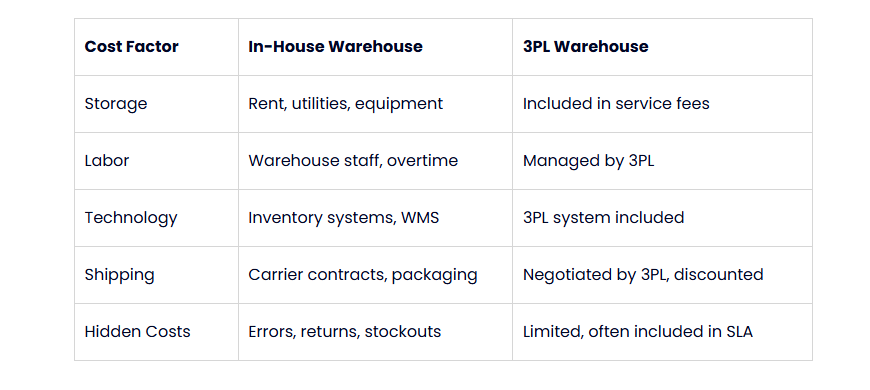
Overall, 3PLs reduce upfront investment and operational complexity, while in-house fulfillment gives full control but requires significant resources.
Which Fulfillment Model Is Right for Your eCommerce Brand?
Your decision depends on your brand’s size, product type, order volume, and long-term strategy.
In-House May Be Better If…
You’re a small brand with low order volume
You require highly customized handling or packaging
You want direct oversight of every step
You’re not ready to outsource core operations
3PL May Be Better If…
Your brand is growing quickly
You want to reduce operating costs
You sell across multiple channels (DTC, wholesale, marketplaces)
You need faster shipping and better automation
You want to focus on branding and sales, not warehouse management
Hybrid Model (In-House + 3PL)
Many high-volume brands keep certain SKUs in-house (premium, custom, bulky items) while outsourcing fast-moving products to a 3PL.
This provides the best balance of control, speed, and scalability.
Decision Framework
- Analyze current order volume and SKU count.
- Consider your ability to invest in warehouse space, staff, and technology.
- Evaluate your need for control over packaging and unboxing.
- Determine whether flexibility and scalability outweigh full control.
- Decide if a hybrid model suits your growth stage and product lines.
Conclusion
There is no one-size-fits-all fulfillment model. In-house logistics gives complete control and flexibility, while 3PL fulfillment delivers speed, efficiency, and scalable growth. The right choice depends on your brand’s stage, product type, and operational priorities.
If your brand wants to grow faster while leaving logistics to professionals, partnering with a reliable 3PL warehouse may be the smarter path.
FFOrder Team
FFOrder helps growing brands run dropshipping and fulfillment as one system — from sourcing across 40,000+ factories to global shipping and structured after-sales.
Is a 3PL Right for Your Ecommerce Brand?
Compare fulfillment requirements, warehouse coverage, technology, packaging, shipping, and costs with FFOrder.
-1200x628%20(14).png)